
Research Arsenal Spotlight 58: Elbert Corbin 1st New York Light Artillery
Elbert Corbin was born in 1835 to Justus Corbin and Amanda (Hibbard) Corbin of Liverpool, New York. He married Emily Marie Noyes in 1857 and they had two sons, Justus “Jutty” and Royal “Roy” Corbin. Elbert’s letters begin in August 1861, one month before he enlisted in Battery B of the 1st New York Light Artillery on September 16, 1861. He was mustered in on September 20.
Travel to Washington
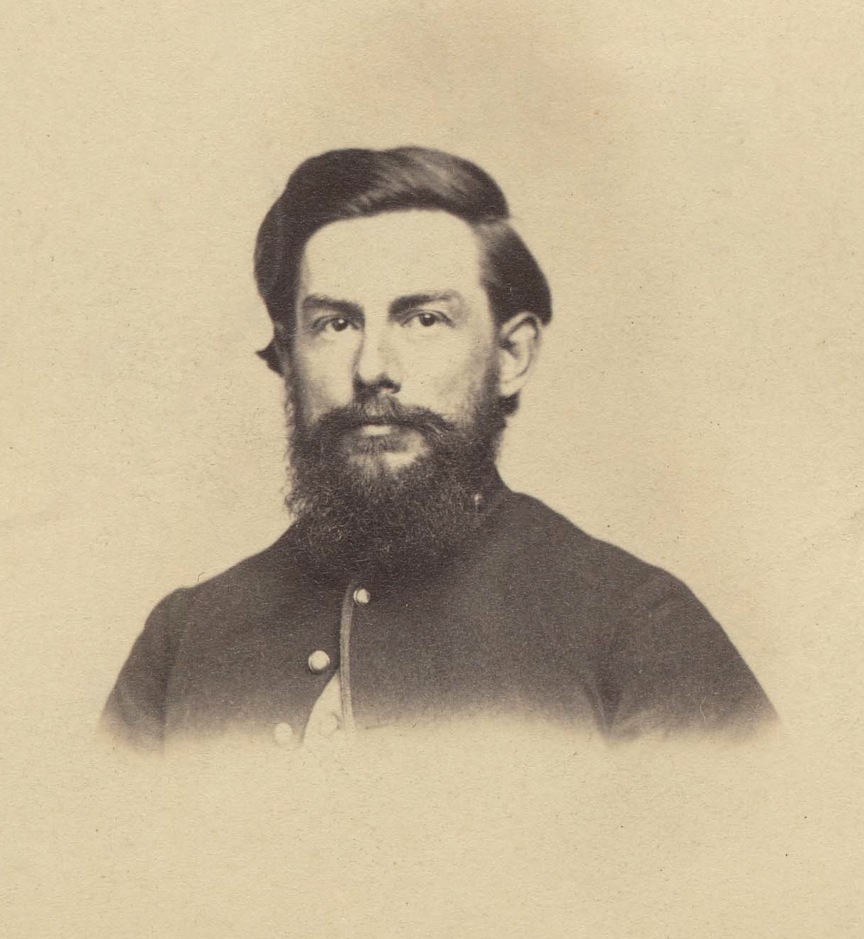
The 1st New York Light Artillery left New York for Washington D.C. on October 31, 1861. However, the journey for Battery B was not an easy one and caused much resentment among the men because they were forced to travel in cattle cars rather than the passenger cars most of the regiment traveled in. In a letter written on November 1, 1861, Elbert Corbin recounted the journey to his wife.
“We being the Left Wing took the last cars, not having passenger cars enough we (our company) had 3 cattle cars. Capt. [John D.] Frank’s company [Battery G] had 1 cattle car (21 passenger cars and 4 cattle cars in the train, 2 engines, then our cannon, horses, and baggage in another train of 15 cars). At 3 o’clock we were ready and started for Williamsport, 80 miles, which we reached at 11 o’clock in the evening. There was but little of the car I was in left when we got to Williamsport—the boys tore it all to pieces they were so mad because they had to ride in such cars. It was better all open than half way. It was a cold night and we slept none. At 12½ midnight we left Williamsport for Harrisburg, stopped on the switches several times for trains to pass. About 1½ at night we stopped on a switch in the woods 2 hours. The 3 cars that our company was in we tore all to pieces and they built a fire of the boards to get warm by so when we left the woods, there was nothing but the platform and frames of the cars left. We had a grand fire. The Major and Colonel told us if we could get in the other cars to do so and set them (the 3) on fire and leave them in the track. But we could not so we had to stay in them.”
Battery B of the 1st New York Light Artillery remained part of the defenses of Washington through March, 1862. On February 1, 1862, Elbert Corbin shared that military life had lost some of its shine to him and he chafed especially at the authoritarian nature of it.
“I begin to see more of the hardships of the soldier’s life. Oh what mud. And it is rain, rain, all the time. Good night dearest. I have seen enough of military life to say this: that it is a perfect control over those under them all the way down to the non-commissioned and they have command over the privates. Tell them to do so and so, and it is must be done, and in the place where the army is the citizens are in fear of the soldiery and they do as they please. If a soldier gets into difficulty with a citizen and he cries soldiers! he has a regiment to back him. This I have seen in several instances wherefore I say that Military laws are perfect despotism in their nature. But goodnight. I am sick. God bless you and keep you, Again goodnight.”
On February 15, 1862, Elbert Corbin wrote about the ineffectiveness of the Confederate blockade of the Potomac River.
“Every night the guns on the [Confederate] blockade [of the Potomac River] is heard, but it is a Putty Blockade. There is a little gunboat here in Alexandria that runs it regular 4 times a week to and from Fortress Monroe and the Oyster fleet has run it, and every night the boats go by. They can’t hit anything. Better [to] save their powder. If I could not hit an Oyster Smack from their batteries, were I in their place, I would give up, load the gunners in the gun, and fire at the moon. They have not hit one boat and they fire at every one.”
1st New York Light Artillery at Yorktown
In April, 1862, Battery B of the 1st New York Light Artillery was part of the Siege of Yorktown, one of the major battles of the Peninsula Campaign. On April 19, 1862, Elbert Corbin wrote about a recent Confederate attempt to seize Union guns and a follow up attack on the Confederate position by Union forces.
“Night before last the Rebels came out as 12½ o’clock and made an attempt to take a gun of ours which they thought was unprotected but the Vermont 6th and 7th Regiment gave them all they wanted. They tried again at 3 but went back with a belly full—i. e., what went back. Some had all the lead they could carry. Some gave up and laid down, thought they would not go back at all. The Vermont Regiment were cut up—some very few killed. Today they were bringing in the wounded [and] sending them to Alexandria.
Wednesday eve there was much firing going on. Our guns got command of a fortification of 8 heavy guns and after some firing on both sides, two companies of the 5th Maine Regiment crossed the river, water up to their arm pits and took it at the point of the bayonet. The guns were spoked and some taken out but they could not hold it for other guns of their commanded the same. But it is of no use to them now. Out of the 190 men who took the fortification, only 26 returned unharmed. The rest were killed, wounded, & missing. There is sharp work going on now on the left for there is a constant firing kept up though it is raining hard at this time.”
The Peninsula Campaign continued through July, 1862.
Elbert Corbin at Gettysburg
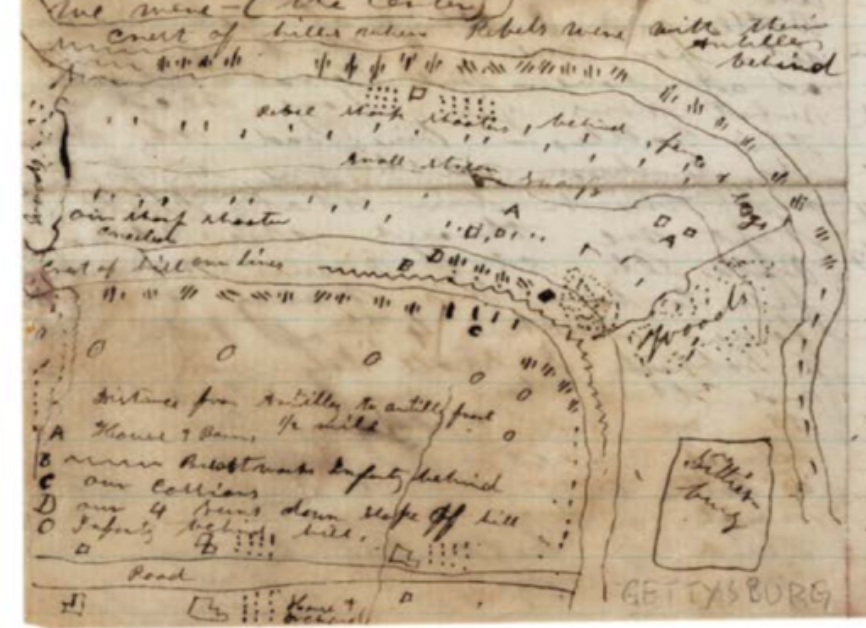
Elbert Corbin’s final letter in the Research Arsenal collection was written on July 5, 1863 right after the battle of Gettysburg. The letter begins with a long list of men wounded in Battery B of the 1st New York Light Artillery, as well as the note that 89 horses were killed and 3 caissons smashed.
The next morning, Elbert Corbin continued his letter with more details. He temporarily assisted the surgeons which were overwhelmed by the number of casualties from the battle.
“After getting off Lt. [Albert S.] Shelden, I dressed our Boys wounds, then 15 or 20 of the Boys of other Batteries. Then I was sent to work assisting to cut out balls and dress the wounded Rebels and we now have any quantity of them and I shall have to help tomorrow. I can do up wounds from shot or shell or bullets quite like an M. D. I have had quite a discipline. I do it for that. I can see an arm or leg taken off and it has no more affect on my feelings than cutting so much beef. Dead men are plenty here and I saw plenty of them in all shapes on the field. [I] help[ed] to wound & kill men, then patch them up. I could show more suffering here in one second than you will see in a life[time] at home. It is strange how I have disciplined my feelings to see dying and suffering men and have no feelings—only a passing thought. I have some [illegible] that were cut out of men.”
Elbert Corbin also blamed the Captain in command of the battery, James McKay Rorty, for poorly positioning it on the field and leading it to take higher casualties.
“Such a 4th of July. Such a Sabbath I shall long remember and three day’s work here among the wounded & dying. But I have learned much. I must say a little why we suffered so much in this battle and I think if Capt. [Rufus D.] Pettit had been here instead of this fool of a [James McKay] Rorty, we should have lost far less. The first day [2 July] we (i.e. our Corps) was thrown in to fill a gap in our lines [the Plum Run Line] where the enemy were massing and here we suffered much. We were driven back about ¼ mile, took another position, and held until we had no support and were ordered out. The second day [3 July] the line of battle was the same shape, only farther back. The enemy had their artillery concealed much and then the position that our Capt. put us in was the worst we could have. Capt. Pettit would never have put us in such a place. I will mark out a little and show a little as to our position and the position Capt. [Pettit] would probably have taken had he been here. I cannot map out the whole but only where we were (the Center).”
Elbert Corbin mustered out at the expiration of his term of service on September 19, 1864. His wife, Emily, died in 1866 and he later married Sarah Letitia Noyes. He died in 1915 at the age of 79.
We’d like to give a special thanks to William Griffing of Spared & Shared for his work in transcribing and sharing these letters.
To read more of Elbert Corbin’s letters as well as access thousands of other Civil War letters and documents, sign up for a Research Arsenal membership.
If you enjoyed this article check out some of our other featured collections like Albert Brown of the 16th Maine Infantry and John Clarkson Jay of the 71st New York National Guard.
