
Research Arsenal Spotlight 62: Otis Whitney 27th Iowa Infantry
Otis Whitney was born in 1821 in Seneca, New York to Otis Whitney and Betsy (Hawley) Whitney. He married Harriett Newell Barnes in 1854 and the pair moved out west to Iowa. He served as a law clerk and acting justice of the peace until becoming the 1st lieutenant of Company H, 27th Iowa Infantry in the fall of 1862.
Initial Organization and Muster of the 27th Iowa Infantry
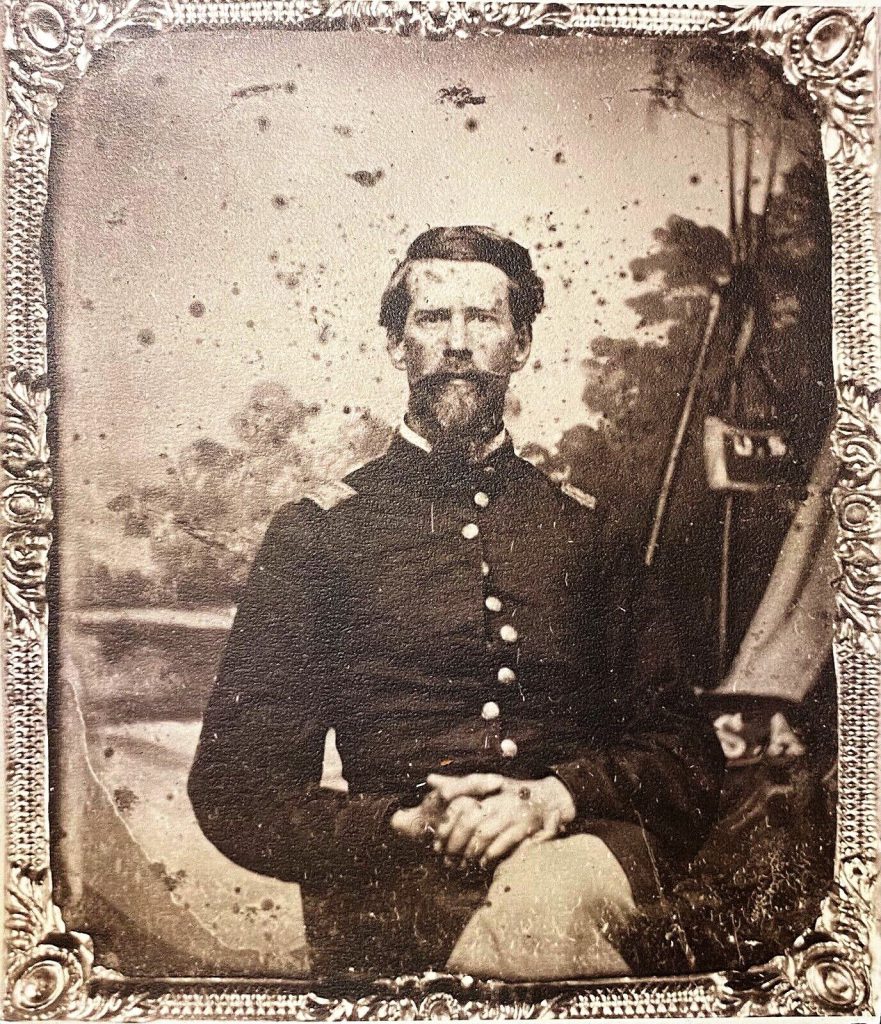
After completing its organization, the 27th Iowa Infantry was initially sent to St. Paul, Minnesota, in October, 1862. The journey ended up more perilous than expected. In a letter written on October 15, 1862, Otis Whitney described a serious accident during their voyage north.
“We embarked Sunday morning & had a pleasant trip with some little adventure. Sunday night, just at dark, a snag (a large tree trunk) smashed through the guard deck near the bow of the boat & came very near throwing some of the boys overboard. A few minutes before there were several standing on the very spot where the crash was made. Last night a steamer coming down undertook for some unexplained reason to run our boat down but by the skill of our pilot, we avoided being struck but in doing so, the stern of the boat was thrown so near the shore that a tree on the shore crashed through the side of the boat & tore out the entire side of the barber shop to the great fright of several men who were sleeping on the floor & in chairs. The fright was not without cause as it came near sweeping off several men.”
The 27th Iowa Infantry was then sent south to Cairo, Illinois, a place Otis Whitney had a less than favorable opinion of.
“You say you hope we will go into winter quarters here. If you could look around & see the position we occupy, you would soon change your mind. It would be difficult selecting as bad a place for quartering soldiers in the state of Iowa as this. It is mud everywhere and such mud as you do not see in Quasqueton. It sticks fast to one’s boots until they are completely loaded down. But this is not the worst of our position. It is very unhealthy. Dr. Hastings is afraid there will not be well ones enough by Saturday night to take care of the sick.
Several of us officers occupy an old shanty on the top of the embankment that keeps the Mississippi and Ohio from overflowing the town in high water. The boys and many of the officers sleep on a level with the Mississippi in ordinary stage of water. The place, Cairo, is one of the most God-forsaken places it has ever been my misfortune to visit. Almost every place is a drinking saloon. The place boasts a theatre all on the ground floor. Steamboats and gunboats swarm.”
27th Iowa Infantry in Mississippi
On November 29, 1862, Otis Whitney wrote to his wife that the regiment had arrived in Mississippi and was currently in pursuit of Confederate forces under the command of General Sterling Price.
“We have an object in view. That is to cut off Van Dorn and Price from forming a junction with Bragg. We look for a battle tomorrow or next day—a severe one. We have had pale cheeks in camp already. I do not intend to say anything to excite your fears. This may be the last letter I can write you & yet I may be spared to write many more & come home to stay for many happy years. God only knows.
It is very possible that Price may run too fast to be caught. If we do intercept him, we shall have a battle.”
When Otis Whitney next wrote on December 6, 1862, they were still pursuing Price, but the likelihood of a battle involving the 27th Iowa Infantry had decreased.
“One thing, however, seems probably certain and that is that we are not very likely to have an action with Price’s forces for the present. I dare say you are glad of it & so am I, although I would try not to flinch from any duty. Price seems to be the prince of Generals at retreat & a middling good fighter when he can engage an enemy far inferior to him in numbers.
The cannonading I wrote you about was Gen. Grant shelling Price out of some fortifications on the Tallahatchie river about four miles from our present camp. Price evacuated in the night precipitously leaving sixteen of his heaviest guns spiked. His night retreat saved his army from being cut off or our division from a defeat. We make no calculations for defeat & with an equal force numerically I think we need not.”
A few weeks later, one December 23, 1862, Otis Whitney described the recent Confederate raid on Holly Springs, Mississippi.
“On Saturday morning (the 20th, I believe) report came into camp that Holly Springs was attacked and taken by the secesh and that a body of their cavalry were on the way to either attack us or pass nearby to destroy a bridge below us. We were accordingly hurried out of quarters with no baggage or provision to march some mile or two, resist the passage, and then return to stay over night. It was afternoon when we started. Reached the post, formed line of battle, stacked arms—built a great high rail fence 30 or 40 rods long (of old rails handy by) then took positions by companies & waited for the enemy. No enemy came, and after waiting two or three hours, word was received to march for Holly Springs by way of Waterford whole distance about 15 miles.”
Otis then briefly backed up his account in order to give more detail.
“On Saturday morning at daylight, 14 secession cavalrymen rushed upon a hospital a mile from our camp, made prisoners of the guards—some 12 in number, took what horses they could find (among them Doctor Hasting’s horse) and left in a hurry. No one in our company had the misfortune to be taken. Doctor Hastings can owe his freedom to the comfortable habit of waiting for the sun to rise first. However, the boys are all paroled as we hear today—out of the service until exchanged.
On Sunday morning early we commenced the march for Holly Springs, nine miles distant, which we reached about 2 p.m. The rebels fled Saturday night after destroying immense army supplies, railroad cars, and burning some of the best blocks in the town. They also destroyed a heavy mail and ransacked the Post Office. They also took some 1000 [prisoners], most of who, they immediately paroled, not having time to parole all. Several were killed and wounded. We cannot learn how many. You can learn by the papers long before we shall know. That is the only way we have of learning what we have done.”
Otis Whitney and the Battle of Nashville
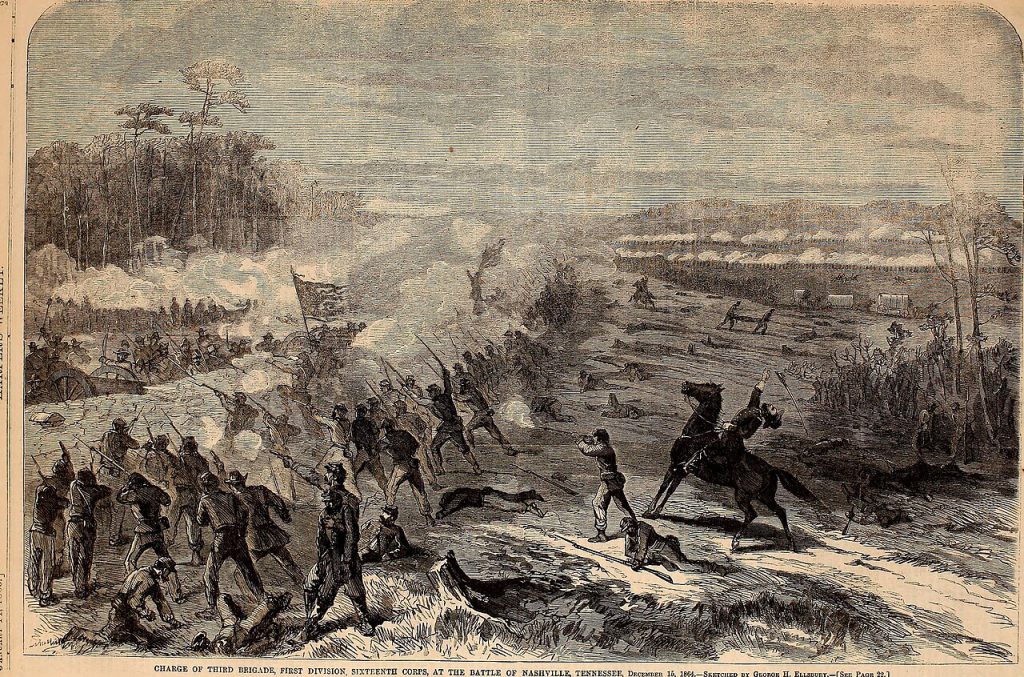
The 27th Iowa Infantry continued to serve throughout the south in 1863, including participating in the capture of Fort DeRussy and the Battle of Tupelo. In December, 1864, the 27th Iowa Infantry was outside of Nashville awaiting an imminent attack by Confederate forces under General John Bell Hood. In a letter written on December 6, 1864, Otis Whitney described the regiment’s readiness for the attack.
“I have seated myself on my roll of blankets & commenced a letter to you not knowing whether I shall have an opportunity to finish before having to fall into line to repel Gen. Hood’s army. We are entrenched behind strong temporary works which we have thrown up since the 3rd inst. We are on a high and commanding hill with a section of a battery planted on it. Cannonading has been going on almost all the time since we took our position with the exception of part of the night & it has just now commenced again 8:30 a.m.
We have no fears of an attack in the daytime, nor much in the night. But a night attack would to a great extent deprive us of the use of our artillery. It is no doubt the intention & policy of the rebels to attack us in the night & then by force of numbers to overwhelm us—precipitating themselves upon us in massed columns with insane and reckless fury, hoping to break our lines. We have a force large enough to whip the rebels in the field, I think, but it is not the intention of our commander to move outside our works to fight. Gen. Hood cannot afford to remain long before the city & if he attempts to retreat, that retreat must soon be converted into a flight. The rebels do not reply to our artillery & have not except once the first afternoon when they planted a section of a battery (2 guns) and attempted to shell us but soon gave up the attempt as useless as they could not reach us with their shell. Judging from appearances, they are short of artillery ammunition. We have a line of entrenchments 7 miles long that is the outside line. Inside are rifle pits and two formidable & very commanding forts full of heavy siege guns.”
Hood’s forces finally attacked and were repelled on December 15 and 16, 1864. On December 20, 1864, Otis Whitney wrote home about the battle and the aftermath.
“You have probably heard long before this all the particulars of the two days fight before Nashville & how the Federal forces defeated Hood’s forces. The battles were on the 15th and 16th. On the 17th our forces commenced the pursuit—that is, the infantry. The cavalry were in pursuit the night after the fight. The roads were very bad & it rained most of the day. The 18th continued the chase & camped long after dark on the battlefield of Franklin with the evidences of the sanguinary contest all around us—cast away knapsacks, haversacks, blankets, cartridge boxes, and various kinds of small arms. Dead horses lay scattered around and new made graves were in the midst of our camp & long rows in sight near our fortifications.”
He also described the fatigue he experienced on the second day of the fight.
“I passed through the battles unharmed but was dreadfully fatigued. In the charge on the 16th, I had a full haversack & canteen, a rubber blanket, and my overcoat which was wet and very heavy. Although not carrying near so much load as many others, I gave out with fatigue for a time and fell behind apiece but regained the front before the line permanently halted.”
Otis Whitney was discharged with his regiment on August 8, 1865. He later moved Oswego, Kansas and died in 1901.
We’d like to give a special thanks to William Griffing of Spared & Shared for transcribing and sharing these letters.
To read more of Otis Whitney’s letters and access thousands of other Civil War letters, sign up for a Research Arsenal membership.
If you enjoyed this article, check out some of our other featured collections like Constantine Hege of the 48th North Carolina Infantry and Gustavus Williams of the 51st Massachusetts Infantry.
