
RG 94 Spotlight: 130th Illinois Infantry
The 130th Illinois Infantry: From Vicksburg to the Red River Campaign
The Research Arsenal is proud to be digitizing and adding historical records of Civil War regiments held at the National Archives to our online database so that researchers and historians can access material that previously required a trip to Washington D.C. The 130th Illinois Infantry is one of the many regiments that has been added to our database.
The 130th Illinois Infantry was one of the many regiments raised in Illinois during the Civil War that entered Federal service in late 1862 and spent much of its existence campaigning in the western theater. Organized at Camp Butler near Springfield, Illinois, the regiment was mustered into service on October 25, 1862, for a three-year term. Its companies were drawn from communities across the state, including Alexander, Bond, Clark, Christian, Coles, Edgar, Monroe, Sangamon, Richland, and Lawrence Counties. From its first months in Memphis through the campaigns at Vicksburg, along the Gulf Coast, and into Texas and Louisiana, the 130th experienced nearly every aspect of a Civil War soldier’s life—including disease, combat, occupation duty, long marches, and ultimately the ordeal of captivity.
The regiment left Camp Butler on November 11, 1862, and arrived at Memphis, Tennessee, six days later. Initially assigned to duty at Fort Pickering, the 130th performed provost duty in Memphis rather than immediately taking the field. For the inexperienced soldiers, however, the period was hardly uneventful. Disease proved particularly deadly. Measles and smallpox swept through the regiment, causing a significant number of deaths before the men had even experienced a major battle. The National Park Service records that the regiment ultimately lost 177 men during its service, including two officers and eighteen enlisted men killed or mortally wounded and another four officers and 153 enlisted men who died from disease.
Vicksburg
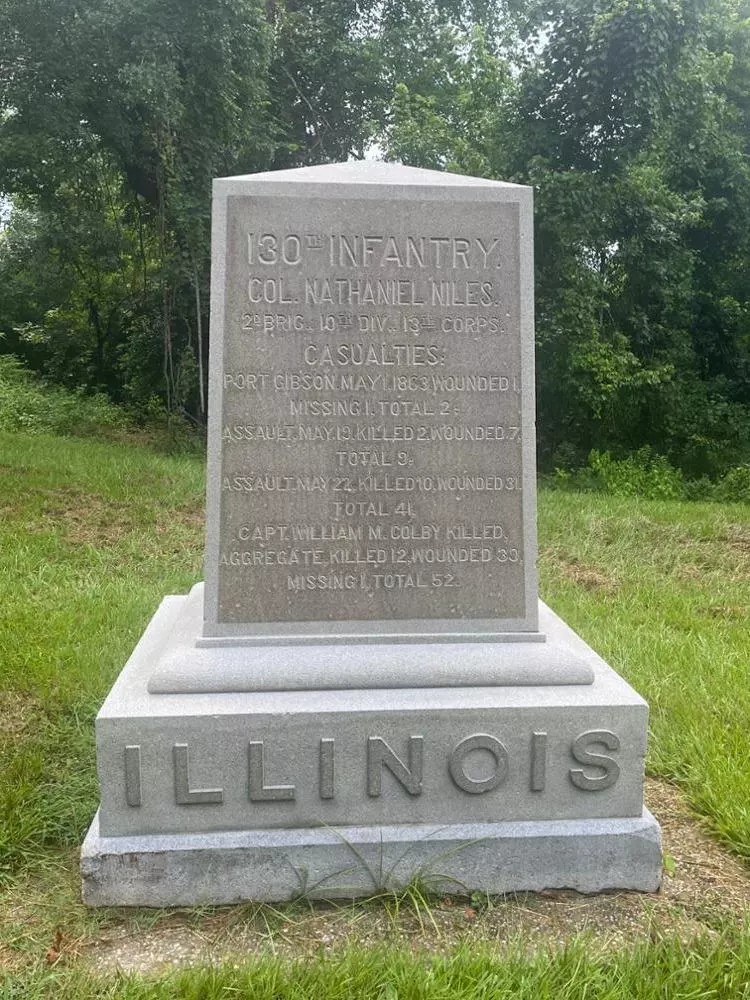
The regiment’s opportunity for active campaigning came in the spring of 1863. On March 27, the 130th left Memphis aboard the steamer J. C. Snow and traveled to Milliken’s Bend, Louisiana, arriving on March 31. There, the regiment became part of the army being assembled for the campaign against Vicksburg. The campaign would carry the Illinois soldiers across the Mississippi River and into some of the hardest fighting of the western theater.
On April 25, the army began its movement toward Bruinsburg. The 130th crossed the Mississippi River on May 1 and marched toward Port Gibson, where it encountered Confederate forces. The regiment’s first combat experience came at the Battle of Port Gibson, where it performed well enough that the Illinois regimental history later remarked that the men “behaved like veterans.” Captain J. R. Johnson of Company H was wounded in the thigh by a shell fragment during the battle.
The campaign continued rapidly. The 130th fought at Champion Hill on May 16 and at Big Black River Bridge on May 17. On May 18, the regiment reached the vicinity of Vicksburg and took part in the investment of the Confederate stronghold. The fighting around Vicksburg was intense and prolonged. On May 22, Captain William H. Colby was killed during an assault, and other members of the regiment were killed or wounded throughout the forty-eight-day siege. When Vicksburg surrendered on July 4, 1863, the men of the 130th had endured weeks of combat, exposure, and constant vigilance.
The surrender did not end the regiment’s campaigning. On July 5, the 130th marched toward Jackson, Mississippi, where Confederate forces had established another fortified position. The Union army besieged Jackson for approximately ten days before Confederate troops withdrew. The 130th then returned toward Vicksburg before being transferred to the Department of the Gulf.
Along the Gulf Coast
The regiment spent part of the remainder of 1863 in Louisiana. It was stationed near New Orleans until October, when it participated in the Western Louisiana Campaign. Moving across Berwick Bay and up Bayou Teche, the regiment eventually reached New Iberia, where it remained on duty with the 99th Illinois while other portions of the army moved farther inland.
This period also brought changes in the regiment’s leadership. Colonel Nathaniel Niles resigned, and Major John B. Reid assumed command. Reid would become one of the most important figures in the regiment’s later history and, ultimately, the field officer who remained with the organization from its formation through its final discharge.
In December, the regiment moved to the Texas coast, spending the winter of 1863–1864 at Decrow’s Point on Matagorda Peninsula. The relatively quiet-sounding assignment concealed the continuing difficulties of campaigning. The men were far from Illinois, far from home, and dependent upon the Army’s complicated system of transportation and supply.
A letter written by Captain John W. Watts of Company I provides an unusually useful glimpse into this less dramatic but essential side of military life.
“We Have Been on the Move Nearly Ever Since”
On February 29, 1864, Watts wrote to the Quartermaster General in Washington regarding the monthly return of camp and garrison equipage for Company I. His subject was not a battle, a heroic charge, or a dramatic encounter with the enemy. Instead, he was attempting to explain why his official records did not properly account for the company’s tents and knapsacks.
Watts explained that the common tents and knapsacks had been issued at Milliken’s Bend on or about April 10, 1863, immediately before the regiment departed for the spring campaign. The problem was that he had never received the invoices necessary to properly account for the equipment. As he explained, “we have been on the move nearly ever since and our Qr. Master has been detached from us.”
That sentence captures something important about the experience of Civil War soldiers that is easy to lose when studying campaigns solely through battle narratives. The 130th Illinois had indeed been almost constantly moving since leaving Milliken’s Bend. In less than a year, its soldiers had traveled from Memphis to Louisiana, crossed the Mississippi, fought their way through Mississippi during the Vicksburg Campaign, participated in the siege of Vicksburg and the movement against Jackson, returned to the Mississippi River, traveled to New Orleans, campaigned through western Louisiana, and then moved to the Texas coast.
Even the regiment’s equipment carried the history of those movements.
Watts explained that he had repeatedly attempted to obtain the necessary invoices but had been unable to do so. He finally took the tents and knapsacks onto his return, with the exception of three tents that had been sent aboard a steamer at Milliken’s Bend. Those tents were subsequently burned at James Plantation, Mississippi, after the vessel was captured or threatened, apparently on the orders of Colonel Owen of the 60th Indiana Volunteers, to prevent the equipment from falling into Confederate hands.
The letter also contains the sort of mundane irregularity that appears frequently in surviving military records. Watts admitted that he was accounting for one more tent than he was officially responsible for, writing, “I can not tell how it came into my possession.” Such a statement may seem insignificant, but it illustrates the difficulties officers faced in maintaining accurate property records while their companies and regiments were constantly moving between camps, transports, battlefields, and temporary posts.
The letter is also significant because Watts was not writing retrospectively. He was dealing with the problem as it existed in February 1864, only weeks before the regiment would embark upon another major campaign. His concern with tents, invoices, and accountability therefore provides a contemporaneous view of the logistical burden carried by officers as the army prepared for further operations.
The Disaster at Mansfield
The 130th Illinois returned to Louisiana in February 1864 and soon became part of the Red River Campaign, a major Union operation intended to advance into the interior of Louisiana and ultimately threaten Confederate control of the region and Texas.
The campaign began in March. The 130th advanced from Franklin toward Alexandria and then continued deeper into Louisiana. On April 8, the regiment encountered Confederate forces at Sabine Cross Roads, also known as the Battle of Mansfield. The battle became one of the most disastrous episodes in the regiment’s history.
The 130th was heavily engaged, and the regiment suffered severe losses. Lieutenant Colonel John B. Reid, commanding the regiment and serving as its only field officer present, was badly wounded when a rifle ball passed through his right lung and body. He was captured and taken to a Confederate hospital. Captain F. D. Phillips was also severely wounded in the knee and later died from his wound, while Captain C. T. Mullen was wounded and died while in Confederate hands.
The regiment itself was nearly destroyed as an effective organization. Most of its men were captured and sent to the Confederate prison camp at Tyler, Texas, where they remained prisoners for approximately thirteen months. Only a small number of men escaped capture and continued with the Union army.
The contrast between Watts’s February letter and what happened only weeks later is striking. When he wrote to the Quartermaster General, Watts was concerned with tents and accounting procedures. The regiment was preparing for another campaign, and the problems of equipment and paperwork were still part of the ordinary business of soldiering. By April, many of the same men would be wounded, killed, or prisoners of war.
Reorganization and the End of the War
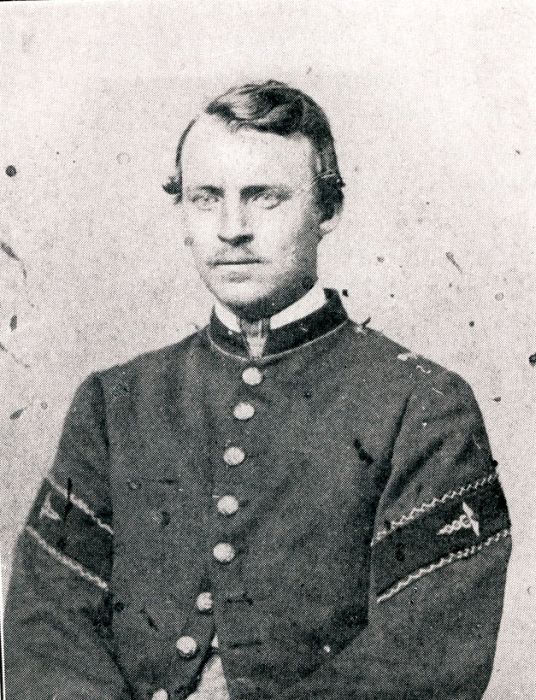
The surviving members of the 130th eventually returned to Union control, while the regiment’s story became intertwined with that of the 77th Illinois Infantry. In January 1865, the 130th was temporarily consolidated with the 77th Illinois. The 130th’s organization was later revived in June 1865, and its remaining officers and men were reorganized into a battalion.
The reconstituted regiment participated in the final Union campaign against Mobile and its defenses. Alongside the 77th Illinois, the men took part in the siege and capture of Spanish Fort and Fort Blakely in Alabama. They subsequently served in the Mobile area and accompanied an expedition up the Tombigbee River to McIntosh Bluffs.
The 130th Illinois was finally mustered out at New Orleans on August 15, 1865. The men then traveled to Springfield, Illinois, where they were paid and formally discharged on August 31.
The service of the 130th Illinois Infantry demonstrates how a Civil War regiment’s history extended far beyond the names of its battles. The men fought at Port Gibson, Champion Hill, Big Black River Bridge, and Vicksburg, endured the hardships of the Gulf Coast, and suffered catastrophic losses at Mansfield. Yet their surviving records also preserve the ordinary details of military life: tents issued without invoices, equipment lost or destroyed during campaigns, officers attempting to keep proper accounts while constantly on the move, and soldiers trying to maintain an organization under extraordinarily difficult circumstances.
Captain John W. Watts’s February 1864 letter is valuable precisely because it concerns such an ordinary matter. His effort to explain a missing invoice and an extra tent offers a glimpse into the machinery behind Civil War armies—and into how quickly that ordinary routine could be shattered. Within weeks of writing the letter, the 130th Illinois would experience one of the worst disasters of its service, with most of its men captured at Mansfield and sent into thirteen months of Confederate imprisonment.
The surviving records of the 130th Illinois therefore allow us to see both sides of Civil War service: the great campaigns remembered in military histories and the everyday problems recorded in the paperwork of individual soldiers and officers. Together, they tell the story of a regiment that spent nearly three years moving from Illinois to Memphis, Vicksburg, Louisiana, Texas, and Alabama before finally returning home in 1865.
Sources
The Research Arsenal is proud to hold 950 digital scans of the 130th Illinois Infantry’s regimental history on its database. These consist of 937 pages of material from the National Archives Records Group 94 files. This comprises Descriptive books, Morning Reports, and Order books. Visit the Research Arsenal, click on “Search NARA Records” then select “RG94” and “130th Illinois Infantry” from the drop-down menus. In addition, the Research Arsenal contains letters, and other forms and documents relating to the 130th Illinois Infantry.
- Illinois USGenWeb Project, “130th Illinois Infantry: Regiment History.” Illinois USGenWeb – 130th Illinois Infantry
- National Park Service, “130th Regiment, Illinois Infantry,” Civil War Battle Unit Details. National Park Service – 130th Illinois Infantry
- Wikipedia, “130th Illinois Infantry Regiment.” Wikipedia – 130th Illinois Infantry Regiment
- John W. Watts, Captain, Company I, 130th Illinois Infantry, letter to the Quartermaster General, Washington, D.C., February 29, 1864. Research Arsenal, image 110476.
Research Arsenal – John W. Watts Letter
