
Research Arsenal Spotlight 87: David Smith 73rd Illinois Infantry
David Smith was born in 1835 to Elias Smith and his first wife, Harriet (Jones) Smith, in Meigs County, Ohio. His family later moved to Vermilion County, Illinois. In March, 1855, David Smith married Elizabeth Ann Cowan and they had several children together (Charles, Robert, and Hattie). On July 12, 1862, David Smith enlisted as a sergeant in Company C, 73rd Illinois Infantry.
David Smith on the road to Tennessee
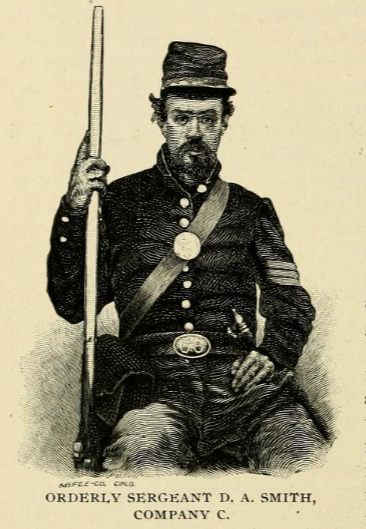
The first letter in our collection was written by David Smith on November 3, 1862, from Bowling Green Kentucky. In the letter, he detailed the long march the 73rd Illinois had made from St. Louis, Missouri to its present location, as well as his belief that their final destination would be Nashville, Tennessee.
“We camped here Saturday evening. This is Monday evening. We have orders to march at 6 o’clock in the morning, I suppose to Nashville, Tennessee. We have marched three hundred miles since we left Louisville. I have stood the march pretty well till the last week. I have been very unwell. I feel better today [but] if we march very hard, I don’t expect that I can keep up. I am going [to] keep up if I can.”
In the same letter, he also revealed that several men in his regiment, most recently a private named Cary Savage, were shooting off their fingers in an attempt to get a discharge from the army.
“There is a good many sick in our company and some of them will get discharges pretty soon. Some of the men is shooting off their fingers to get discharges. Cary A. Savage shot off his finger. It is the belief among the boys that he shot off his finger to get a discharge. There has been three cases of the kind in our regiment. This thing of playing soldier is pretty hard business sure, but if I lose any of my bones in this Rebel land, the Rebels will have to take them off without I do meet with an accident and get hurt. They had one chance at me but I come out close without a scratch and I think that Providence favored me for I didn’t have any fears when I went into the Battle [of Perrysville] of getting hurt and I hated to stop shooting when the Rebels started to run. The officers had to run down and wave their swords and hollow for a good bit before they could get the men to stop shooting. And I believe if our commander had told us to charge on the Rebels, I believe we would have taken all of the Rebels.”
On December 3, 1862, David Smith wrote about recent fighting by regiments under Union General Jefferson Davis in the area near Mill Creek, Tennessee.
“December 3rd—I have just come off guard. We have been guarding the General’s Headquarters. It snowed and rained some last night although the weather is very fine here.
There was pretty hard fighting one day last week on our right. It was Jeff C. Davis’s Division that had the fight. The Rebels took several of our men prisoners although they drove the Rebels back some distance with some loss. I don’t know how much.”
The 73rd Illinois Infantry near Murfreesboro, Tennessee
On January 21, 1863, David Smith wrote from near Murfreesboro, Tennessee. He described the foraging done by soldiers, which was mostly overlooked by their commanding officers as long as they stayed relatively discrete.
“It is very wet here. It has rained and snowed nearly every day since the Battle [of Stone River]. We went out foraging yesterday and it was very bad going. We had to go about six miles. All of our brigade went to guard the train but we didn’t see any Rebs. We got about one hundred wagon-loads of forage besides lots of hogs, sheep, turkeys, geese, and chickens. The latter the boys foraged privately and have to keep hid from the officers. They don’t care how much we kill if we keep it hid. Our company got one shoat. Our mess got one-fourth of him today. We haven’t done anything but sit around the fire. When we come in from foraging, we was startled by the news of the death of Old Man Nicholson. We left him at Nashville hearty and well. It is a wonder to me that A[lexander] C. Nicholson isn’t dead too for he is [the] wickedest man I ever saw. Elick started to Nashville this morning to see about the remains of his father. He started off swearing.”
On February 13, 1863, David Smith wrote a letter referencing a now missing letter describing the Battle of Stone River. He also had rather harsh words about the second lieutenant of his company, William R. Lawrence.
“I wrote you a letter the other day explaining my conduct on the day of the battle [at Stone River] and I hope you will be more satisfied when you read it. I would rather have ten thousand Rebel bullets through me than to have the name that Bill [Lt. William R.] Lawrence has here. The opinion is here that he is a coward and that he gave himself up to keep out of the service as long as possible. Some of the boys say they won’t serve under him if he does come back.”
In the same letter, he also revealed that the soldier who had shot his finger off some months before had received a dishonorable discharge.
“We were today officially notified of the dishonorable discharge of Cary A. Savage of our company. He shot one of his fingers off to evade the service.”
On March 24, 1863, David Smith wrote about a recent skirmish on the picket line of the 73rd Illinois Infantry.
“We moved camp which the most of the Army did the same thing. We moved in closer to the city and more out of sight which I suppose caused the Rebels to think that we had evacuated Murfreesboro for on Saturday our boys went on picket.
In the first place, the picket were drawn in about one mile and the Rebs not knowing where our lines were, came up a little too close on our boys. There was picket firing all night and in the morning, just at daylight, the picket firing commenced pretty sharp. So A[lexander] C. Nicholson and myself gathered our old guns and put out for the boys on the double quick, the distance being about 3 miles, and by the time we got there, the Rebs—finding that our pickets wouldn’t drive worth a cent—they began to haul off and I got there just in time to get a shot at a Reb though he fired first. His ball struck in a stick of wood about a rod from me. Then I thought it was my time but he was so far off and in the brush that I don’t think that I hit him. James Maudlin of our company emptied a saddle for one of them and a man in Company G killed a horse under one man. The fighting was pretty sharp just about daylight and till sunup but none of our boys got hurt but some of them grazed pretty close.
The Rebs used artillery and musketry both on us but they couldn’t drive the pickets. The pickets killed three Rebs last night as they was crossing the river. We suppose they was coming to give themselves up as they had no guns and that they didn’t know where our pickets were.”
Continued Friction with Lieutenant William Lawrence
On April 11, 1863, the 73rd Illinois Infantry was still doing duty outside Murfreesboro, Tennessee. In a letter home, David Smith described the recent shootings of deserters as well as a spy that attempted to move through their picket lines.
“Our Brigade went to Salem yesterday to do outpost picket duty. There isn’t anything of interest going on here now though they are shooting some deserters here. They shot one yesterday and there is one to be shot on the 14th of this month. The pickets also killed a spy this week as he was making through the picket lines. He had been trying to get through the lines for some time but couldn’t make it. He got through the lines this time but the pickets saw him and called him and called him to halt but he didn’t heed these [warnings]. The second halt they sent a messenger after him and one that halted him too. They shot him twice before they could capture him—the first shot taking effect only in his leg and not breaking any bones, [and] he could [still] run. But after they gave him the second shot, he halted in a hurry.”
A little over a month later, Lieutenant William Lawrence returned to the regiment after his capture at the Battle of Stone River and was met by fierce hostility from David Smith and many other members of the company, as David Smith described in a letter dated May 31, 1863.
“William R. Lawrence is in camp looking as pompous as the biggest man in the world but we are going to cut his pinfeathers some of these days. We have got up a petition for him to resign his hard worked for and disgraced position in our company. We have a petition with nearly forty names on it. We have about 5 or six big cowards in our company that holds up for him such as Isaac [R.] Thornton and [Corp. David] McDonald and some others. It isn’t worth while to mention any more names. You needn’t say anything about this part of your letter. You may tell Rob if you want to. He may not resign on the presentation of the petition. If he don’t, we shall court martial him, We have the evidence to do it. He has disgraced his shoulder straps, Now we are going to disgrace him if we can. So that is enough about the coward.”
Despite David Smith’s threats, William R. Lawrence never faced a court martial and was promoted to first lieutenant of Company C in August 1863. He resigned from the service in October, 1863. A personal account by William R. Lawrence about his time as a prisoner of war is included in the regimental history of the 73rd Illinois Infantry.
David Smith was killed at the Battle of Chickamauga on September 20, 1863.
We’d like to give a special thanks to William Griffing of Spared & Shared for his work in transcribing and sharing these letters.
To read more of David Smith’s letters as well as access thousands of other Civil War letters and documents, sign up for a Research Arsenal membership.
If you enjoyed this article, check out some of our other featured collections like Alexander Lyle of the 2nd New Hampshire Infantry and Hosea Paul with the US Christian Commission.
