
Research Arsenal Spotlight 42: Henry Cole Smith 8th Connecticut Infantry
Henry Cole Smith was born in 1845 to Marcus DeForest Smith and Harriet (Cole) Smith of Kent, Connecticut. He was just fifteen years old when he enlisted in Company E of the 8th Connecticut Infantry on September 28, 1861.
The nine letters in the Research Arsenal collection were written to a friend of Henry Cole Smith named Nancy L. Harrison.
Henry Cole Smith in Virginia

The first letter in our collection was written from Suffolk, Virginia on May 10, 1863. At the time the 8th Connecticut Infantry had recently been involved in the siege of Suffolk. Henry Cole Smith wrote to Nancy about the 8th Connecticut Infantry’s successful capture of a Confederate battery.
“You have probably read about our taking the rebel battery the other side of the river, so I shall not need to say much about that. I was there of course. I fired my rifle 3 times. None of the boys fired more times than that, with one of our rifles, but those who had Sharps Rifles fired 5 times. Some of the boys fired none. One man of this company was wounded in his arm and leg but not seriously.”
Henry Cole Smith also shared his hopes that Fredericksburg would be taken soon and that it would bring the war to a close.
“There is a great anxiety felt here for Gen. Hooker. I hope he may succeed in his attempt to drive the rebels from their stronghold round Fredericksburg. I think there will be some chance for this war to end in 8 or 10 months after he has driven the enemy from Fredericksburg.”
One June 28, 1863, Henry Cole Smith wrote another letter to Nancy, this time from White House Landing, Virginia. He described the (now burned) house where they were staying and its long history.
“The house from which this place took its name has been burned. It was burned when General McClellan evacuated this place last year. The house (I should judge from the foundation) must have been a very pretty one and was owned by Brigadier General F. H. Lee of the rebel army. He also owned the farm on which we are encamped. About an hour since, I saw an old Negro 102 years old. He says he can remember when General Washington was married in the “White House.”
While George Washington was at the Custis family’s “White House” the marriage was in 1759 and even if the man were 102 he would have been too young to have witnessed the marriage himself.
Along with the description, Henry Cole Smith’s letter also included a few plant specimens from the White House and surrounding area.
“I will enclose a few flowers—the pink Larkspur I picked in the ‘White House’ garden and the white French Lilac came from the same place. The leaf came from the Dismal Swamp and the other flowers I picked near Suffolk. And that little yellow clove I picked near Yorktown. We were encamped there 3 days.”
Henry Cole Smith in 1864
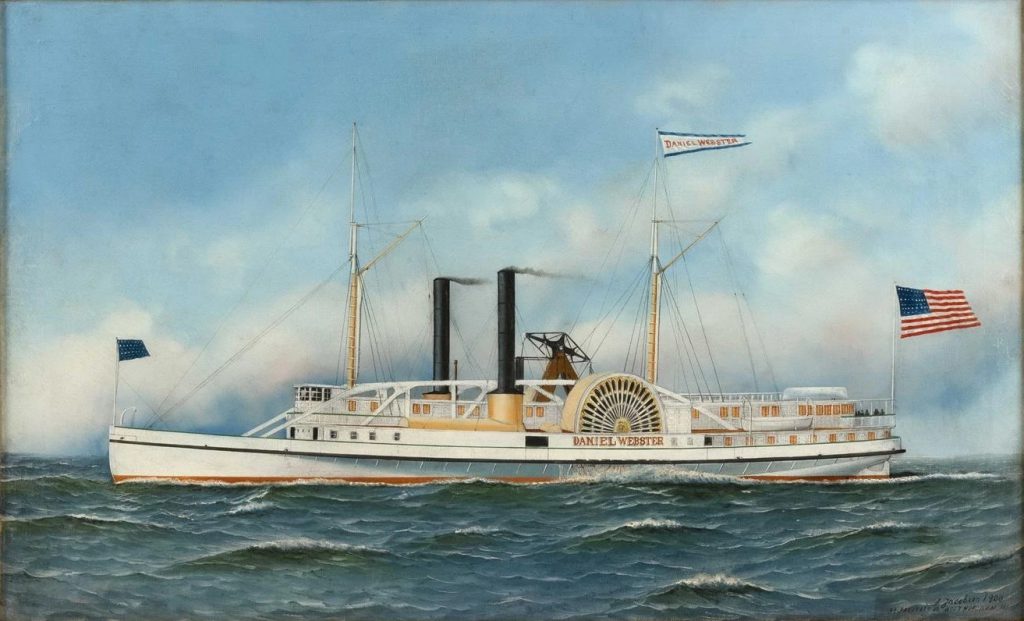
Henry Cole Smith reenlisted as a veteran in the 8th Connecticut Infantry on December 23, 1863. In a letter from March 2, 1864, Henry Cole Smith described the regiment’s voyage on board the steamer ship Daniel Webster after spending some time in New Haven, Connecticut.
“We left Wallingford Saturday P. M. that evening we went aboard the steamer Daniel Webster, that which was lying at the end of the “long wharf”, New Haven. We never were so crowded aboard a boat as much as we were aboard this boat. The first night the orderly (E. Wadhams) and I slept together on the deck. The second day one of the boys broke into an empty stateroom and occupied one of the bunks. I went in and monopolized the other bunk so I was better off than most of the boys. The ocean was not very rough so we may say our passage down was quite a pleasant one, but it was slow as we were going toward the wind all the time.”
A little further in the letter, Henry Cole Smith said he felt more at home with the regiment than he did back in Connecticut, which might also explain some of his reasons for reenlisting.
“The boys are in very good spirits. I feel more at home than I did when I was in Cornwall. I felt out of my place when I was there and now I feel as if I am where I belong.”
A little over a week later, on March 8, 1864, Henry Cole Smith revealed that he was currently studying to take the examination for a commission in a US Colored Troops regiment.
“I have been studying the “tactics” so I feel pretty well prepared for an examination whenever I am called upon. If I receive an appointment in a Colored Regiment—either the 29th or 30th Connecticut—I will probably be able to visit Cornwall before the regiment leaves the state, and in that case if I do not stay with you later than I did the last night, it will be strange.”
Henry Cole Smith also wrote to Nancy on March 26, 1864, and describe the construction of the camp of the 8th Connecticut Infantry currently located outside of Deep Creek, Virginia.
“Yesterday I was detailed for guard and on guard mount the Adjutant detailed me for “Orderly” so I could not answer your letter yesterday. You perceive that we have moved camp by the heading of this letter, which we did the 12th and now are encamped on the left bank of the “Southern Branch” of the Elizabeth River—or as it is called here by the citizens, “Deep Creek.” The soil is quite sandy, the surface about 12 feet above the water. In the summer I think we will find a good breeze on this bank. We have not the “old log house? but we have a house which is quite comfortable and very much the same shape as the “Hall” was but not as large. Instead of a “fireplace,” we have a stove. And instead of logs, we have the sides of the house built of “shakes” as the Negroes call them. To make them the Negroes cut down large pine trees, saw them up in pieces from 4 feet to 6 feet long, then take a “fro” and split the blocks up with strips about ½ inch thick and from 3 inches to 6 inches wide, which we have to use in the South for boards.”
Henry Cole Smith on the March
After outfitting their new recruits with rifles, the 8th Connecticut Infantry went on some long marches in April, 1864. These long marches took a toll on the soldiers and on April 16, 1864, Henry Cole Smith wrote a letter detailing his own method to try and get through them as well as he could.
“I think the men had sorer feet on this march than ever before because we got them so wet the night before, and then we marched about 30 miles that day. My feet were not as sore as a great many were and that evening when I took off my boots & stockings on the bank of a little brook to soak my feet in the water to take the fever out of them, I found the skin had been worn off in several places and that my feet were rather bloody. I think my feet would have been so sore. I could not have walked on them if I had not used a preventative which was to rub soap on them, which made my stockings stick to my feet and instead of my stockings slipping on my feet, my boots slipped on my stockings. This I have tried several times and found it was a great help to me on a march. I have told others of it also and they do so also.”
On March 18, 1865, Henry Cole Smith wrote to Nancy that he soon expected to be discharged but asked her to keep it a secret.
“Nancy I guess the time is not far distant when you may look in earnest for me. By this I mean that I have great hopes of being discharged on account of disability contracted in the pursuance of my duties as a soldier while marching. Still you must not make up your mind that I am to be discharged for you might get disappointed again. Please keep this a secret, for if I succeed, I wish to surprise Cornwall people. You and “my people” are the only ones that know there is such a move on foot, I guess.”
Henry Cole Smith’s prediction was correct and he was officially discharged for disability on March 28, 1865, because of a hernia. He died in 1917.
We’d like to give a special thanks to William Griffing of Spared & Shared for his work in transcribing and sharing these letters.
To read more of Henry Cole Smith’s letters as well as thousands of other Civil War letters and documents, sign up for a Research Arsenal membership.
If you enjoyed this article, check out some of our other featured collections like William Prince of the Ordnance Department and Benjamin Hulburd of the 2nd Vermont Infantry.
