
RG 94 Spotlight: 1st New York Light Artillery
RG 94 Spotlight: The 1st New York Light Artillery
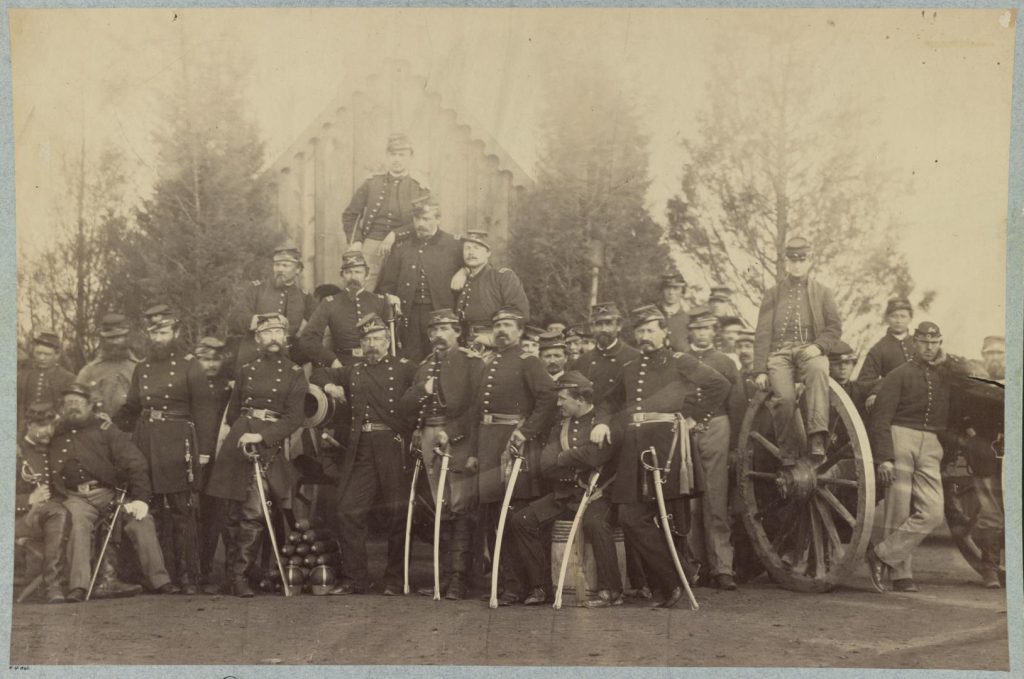
The Research Arsenal is proud to be digitizing and adding historical records of Civil War regiments held at the National Archives to our online database so that researchers and historians can access material that previously required a trip to Washington D.C. The 1st New York Light Artillery is one of the many regiments that has been added to our database.
The 1st New York Light Artillery was one of the larger and more widely dispersed artillery organizations raised in New York during the Civil War. Organized at Elmira in 1861, the regiment eventually served through virtually the entire war, with its batteries assigned to armies and corps ranging from the Army of the Potomac to the Army of the Cumberland and Army of Georgia. Known as Morgan’s Light Artillery, the regiment saw service in some of the war’s most important campaigns, although its individual batteries often followed very different paths.
Unlike a conventional infantry regiment that generally operated together, the 1st New York Light Artillery functioned primarily through its separate batteries. This meant that men who shared the same regimental designation could find themselves serving hundreds of miles apart. Some batteries participated in major battles such as Fair Oaks, Antietam, Fredericksburg, Chancellorsville, Gettysburg, the Wilderness, Spotsylvania, Cold Harbor, and Petersburg, while others spent much of their service in garrison or defensive duties.
Organizing Morgan’s Light Artillery
The regiment was organized at Elmira in the fall of 1861. It received its numerical designation on October 16, and eight companies under Colonel Guilford D. Bailey left New York on October 31. Companies I, K, L, and M followed on November 21. The companies had been recruited from numerous counties across central and northern New York, including Oswego, Oneida, Onondaga, Chemung, Steuben, Monroe, Wayne, Erie, Niagara, Jefferson, St. Lawrence, Lewis, and Herkimer.
The regiment was initially organized for three years, but when that term expired, veterans and recruits remained in service. Its field and staff were eventually mustered out at Elmira on June 21, 1865, under Colonel Charles S. Wainwright. By then, the men had served in the Armies of the Potomac, Virginia, the Cumberland, and Georgia.
The regiment’s early history was also marked by tragedy. Colonel Guilford D. Bailey and Major David H. Van Valkenburgh were both killed at Fair Oaks, Virginia, on May 31, 1862. Bailey’s death removed the regiment’s original commander only months after it had entered Federal service.
The Battery Was the Soldier’s World
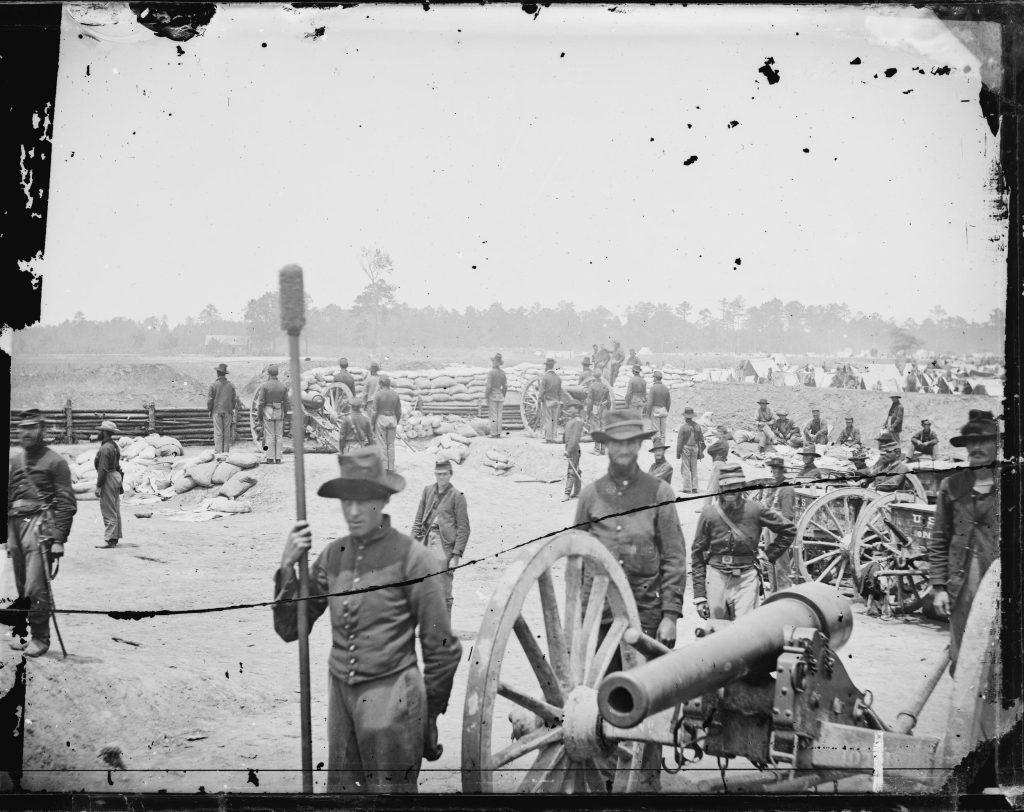
For the individual artilleryman, the battery was often more important than the regiment as a whole. The 1st New York included Batteries A through M, and the service of these units could be dramatically different.
Battery E, for example, moved to Washington in late 1861 and subsequently served with the Army of the Potomac through many of its major campaigns. The National Park Service records its participation in the Peninsula Campaign, Williamsburg, the Seven Days Battles, Second Bull Run, South Mountain, Antietam, Fredericksburg, Chancellorsville, Gettysburg, the Bristoe and Mine Run campaigns, and the campaigns of 1864 through Petersburg.
Battery F followed a very different pattern. Organized at Elmira and mustered in on September 14, 1861, it spent the winter of 1861–62 at Camp Barry in Washington. It accompanied the army toward Virginia and the Peninsula in 1862, but much of its subsequent service consisted of garrison duty at Yorktown and in the defenses of Washington. The battery did not suffer casualties in action, but fourteen men died from disease and other causes.
The contrast illustrates an important reality of Civil War service: being part of a regiment that fought at famous battles did not necessarily mean that every soldier experienced those battles firsthand.
A Soldier’s View of Battery E
One of the most revealing accounts associated with the regiment comes from Nelson A. Daines, an artificer in Battery E. Daines enlisted in September 1861 and served through some of the most important campaigns of the Army of the Potomac. His service record placed him at engagements including Lee’s Mills, Yorktown, Williamsburg, Fair Oaks, the Seven Days, Second Bull Run, South Mountain, Antietam, Fredericksburg, Chancellorsville, Gettysburg, Mine Run, the Wilderness, Spotsylvania, North Anna, Cold Harbor, Petersburg, and the Weldon Railroad.
Daines’ letters also provide a glimpse into the less dramatic work required to keep an artillery battery operating. Writing from Washington in December 1861, he explained to his wife that he was working as an artificer, serving as the boss of the blacksmith shop and battery wagon. He noted that the battery had ninety-four horses and that his “shop is outdoors.”
The enormous logistical demands of artillery are apparent in another letter written in February 1862. Daines estimated that his battery required 1,300 horses to move its guns, equipment, and baggage. The artilleryman was not simply a man who stood beside a cannon and fired it. Horses, harness, ammunition, wagons, equipment, mechanics, and specialists were all necessary to put the guns into action.
Daines’ letters also reveal the emotional side of military service. Separated from his wife and son, he wrote that he would like nothing better than to see them. Yet he remained committed to his service, declaring that if he fell, he would “sell my life as dear as possible” and stand by the flag.
His later service demonstrates how long and arduous the war could be for artillerymen. Daines reenlisted in December 1863 and was transferred to Battery L in June 1864. He remained in service until June 17, 1865. Despite participating in numerous campaigns, he later recalled that he was never sick for an hour and had never spent time in a hospital except to care for sick and wounded soldiers.
Battery F and the Reality of Disease
The surviving testimony from Battery F offers a useful counterpoint to Daines’ combat experiences. In October 1862, while the battery was stationed at Yorktown, the noncommissioned officers and privates presented Assistant Surgeon Daniel Pardee with a testimonial expressing their appreciation for his service.
The soldiers explained that Pardee had arrived among them as “an entire stranger,” but that his sympathy and medical skill had earned their gratitude during a period of “unusual sickness.” Their testimony is a reminder that disease was an ever-present danger in Civil War camps, even for soldiers whose batteries did not experience heavy combat.
Battery F ultimately lost fourteen men to disease and other causes. Its experience also demonstrates why a soldier’s wartime story cannot be measured solely by a list of battles. Long periods of garrison duty, illness, drills, maintenance, marching, and waiting were all part of military life.
The 1st New York Light Artillery at Gettysburg
Some batteries of the 1st New York Light Artillery played an important role at Gettysburg. Newspaper accounts preserved by the New York State Military Museum include Major Thomas W. Osborne’s report describing the artillery position on Cemetery Hill during the battle.
Osborne described the careful placement of batteries so that they could support one another without interfering with each other’s fire. During the fighting on July 2, Confederate artillery concentrated heavily on the Federal position. Osborne reported that the Union batteries continued firing despite the intensity of the bombardment, and that several Confederate batteries were silenced.
The fighting became particularly intense when Confederate infantry attacked Wiedrich’s Battery. According to the contemporary account, the infantry initially gave way and the battery was briefly exposed to capture. The artillerymen then rallied alongside the infantry, seized whatever weapons they could find, and joined the counterattack. Canister was used against the attacking Confederates.
The following day brought an even greater artillery bombardment. Osborne described Confederate guns opening along the Federal front and concentrating their fire on the Union position. The Federal artillery endured the bombardment before turning its guns against Pickett’s Charge. Osborne believed the artillery fire from Cemetery Hill played a major role in breaking up the Confederate advance.
The newspaper coverage also shows how the achievements of individual batteries were remembered at home. One article praised Captain John A. Reynolds and his battery, noting that it had participated in some of the war’s hottest engagements and had been relied upon by its commanders. During the retreat from Chancellorsville, the battery reportedly helped cover the withdrawing troops at United States Ford.
Soldiers, Families, and the Home Front
The newspaper clippings associated with the regiment provide another perspective on the war. They record promotions, recruiting efforts, wounded soldiers, returning veterans, and even money sent home by men serving in the batteries.
In 1863, for example, soldiers of Battery G sent substantial sums of money home through the American Express Company. The published list included dozens of men and amounts ranging from $15 to several hundred dollars. Captain Nelson Ames himself was listed as sending $350.
Such notices demonstrate how closely the soldiers remained connected to their communities in New York. The men were fighting hundreds of miles from home, but their families and neighbors followed their careers through newspapers, letters, furloughs, promotions, casualty lists, and financial remittances.
By 1864, newspapers were still reporting promotions within the regiment. Sergeant L. W. Scott was promoted to second lieutenant and subsequently to first lieutenant, while First Sergeant Hiram H. Schell was promoted to second lieutenant. These announcements were not simply military news; they were news about local men whose families and communities had a personal interest in their careers.
Four Years of Service
The story of the 1st New York Light Artillery is ultimately the story of many different batteries and thousands of individual soldiers. Some fought repeatedly in the major battles of the Eastern Theater. Others spent months or years performing garrison duty. Still others served as mechanics, artificers, teamsters, clerks, or medical personnel whose work was essential to keeping the batteries operational.
The regiment suffered significant losses during its four years of service. According to the New York State Military Museum, five officers and fifty-four enlisted men were killed in action; one officer and forty-one enlisted men died from wounds; and five officers and 161 enlisted men died from disease and other causes. In all, 267 men of the regiment died during the war, including nine enlisted men who died while in Confederate hands.
When the surviving members finally returned to New York in 1865, they brought home experiences that varied enormously from one battery to another. Their letters, newspaper accounts, official records, and surviving histories allow us to reconstruct those experiences today.
The 1st New York Light Artillery therefore deserves to be remembered not merely as a single regiment, but as a collection of batteries whose men served in very different circumstances. From the muddy camps around Washington to the battlefields of the Peninsula, Antietam, Chancellorsville, and Gettysburg, and ultimately through the campaigns of 1864 and the final operations against Petersburg, Morgan’s Light Artillery remained in Federal service until the end of the war. Its surviving correspondence makes clear that behind the movements of batteries and the reports of battles were individual men thinking about their families, caring for their comrades, maintaining their equipment, and trying to survive a war that would keep them away from home for years.
Sources
The Research Arsenal is proud to hold 1,296 digital scans of the 1st New York Light Artillery’s regimental history on its database. These consist of 1,250 pages of material from the National Archives Records Group 94 files. This comprises Descriptive books, Morning Reports, and Order books. Visit the Research Arsenal, click on “Search NARA Records” then select “RG94” and “1st New York Light Artillery” from the drop-down menus. In addition, the Research Arsenal contains letters, and other forms and documents relating to the 1st New York Light Artillery.
- New York State Military Museum — 1st Artillery Regiment (Light)
- New York State Military Museum — 1st New York Light Artillery Newspaper Clippings
- National Park Service — 1st New York Light Artillery Battle Unit Details
- Spared & Shared — 1st New York Light Artillery
- Spared & Shared — Battery F, 1st New York Artillery, 1862
- HathiTrust Digital Library — History of Battery G, 1st Regiment New York Light Artillery by Nelson Ames
