
Research Arsenal Spotlight 52: Theodore Vaill 2nd Connecticut Heavy Artillery
A few weeks ago we highlighted our collection of letters by Joseph Vaill, this week our focus is on his brother, Theodore Vaill of the 2nd Connecticut Heavy Artillery.
Theodore Vaille was born in 1832 to Reverend Herman Vaill and Flora (Gold) Vaill of Litchfield Connecticut. He originally enlisted in the 19th Connecticut Infantry in 1862. On November 23, 1863, the 19th Connecticut Infantry was redesignated as the 2nd Connecticut Heavy Artillery.
Theodore Vaill on duty near Washington, D.C.
Before becoming the 2nd Connecticut Heavy Artillery, the 19th Connecticut Infantry spent most of its service as part of the defenses for Washington, D.C. On November 29, 1862, Theodore Vaill wrote home about his current duty of guarding large amounts of commissary stores.
“I am on guard from 10 till 12 tonight in a building as long as from our west barn to John Plumb’s, and filled with boxes of nothing but Army bread. All I have to do is to sit here with a light, or stand here, and protect this mountain of bread on a box of which I am now sitting. Three [civilian] watchmen are here besides, but I am here, I suppose, to represent the military power of the government.
Wm. Hull is doing similar duty in a precisely similar building only his charge consists of several thousand barrels of pork, beef, coffee, rice, sugar, & molasses. You would think by the squealing & galloping & clawing & nibbling that the rats were trying to carry off the whole vast concern. We like this duty better than being in camp & we hope to stay here a long time yet.”
On February 3, 1863, Theodore Vaill described the area around Fort Worth, a Union fortification outside of Alexandria.
“There are 15,000 acres of stumps right here where the trees have been cut about two feet from the ground to impede the enemy’s artillery in case of an attack on Washington and we have to cut these stumps off lower down or freeze which isn’t nice.”
A few months later he shared an amusing anecdote of several soldiers sneaking out after taps was called, only to return and find that their companies had been ordered to move during the night.
“Last night (at 1 o’clock this a. m.) we were waked up very suddenly by orders for companies A, D, & C to fall in with arms & blankets which they did (as soon as they get their eyes open), & marched to relieve the garrison at redoubts A, B. & C near Fort Lyon. It was done so still that hardly a man of the other companies knew of it until this morning. Of course I don’t go, being wanted here. Leonard Bissell leaves for home with Hen. Kinney today. So I shall have all the tent to myself. One tent squad of Co. D have got themselves into a sweet pickle. They went off after taps last night on a lark (as they frequently do) to “Allicks” or somewhere intending to get back & tun in toward morning so as to be on hand at reveille. But the order for their company to move instantly was not down in their programme & the company went without them. In due time they came skulking home and were nabbed instanter, and are now putting up at the hotel de garde house & will probably ride out for exercise this morning on the prancing steed with fast legs. Two or three corporals & sergeants among them will probably lose their stripes.”
The appointment of Elisha S. Kellogg as Colonel
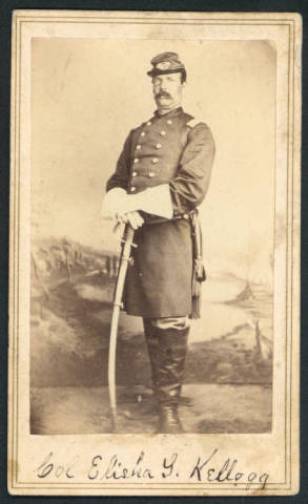
On October 27, 1863, Theodore Vaill was very anxious over who would be the new colonel of the 2nd Connecticut Heavy Artillery (still designated the 19th Connecticut Infantry for a few weeks more). He was in hope that the colonel would be Lieutenant Colonel Elisha S. Kellogg, but there were worries that a previous confrontation with Major Nathaniel Smith might have taken him out of consideration. Theodore Vaill forwarded a copy of a letter written by Anna Welles, the niece of Elisha Kellogg, describing a meeting she and her father had with the governor of Connecticut.
“The Governor stated fully & frankly the objections in his mind—summed up in the statement that while he acknowledged your [Kellogg’s] superior ability as a military officer, he had reason to believe you were overbearing, passionate, and sometimes lost control of yourself. In other words, you had been known to be under the influence of liquor, & at such times overworked your men. And last Spring you sent for Maj. Smith to come to your tent, you turned over to him the property &c, of the regiment—your language to him was very profane & finally you kicked him.
Though we had not heard that circumstance, Father & I denied emphatically the kicking part of the story. Father presented to him the subject in this light. That you were restored to your command last Spring, without trial, or even a reprimand, by order of the Secretary of War, upon the recommendation of General Heintzelman & that was sufficient to cancel whatever was inconsiderate at the time.”
Along with the copied letter, Theodore Vaill included his own thoughts about the matter.
“About the kicking story, &c., I don’t know just what the truth is, but I know that Kellogg & Smith are thick enough now, and have been all summer. That affair was settled between them by a very humble apology on Kellogg’s part & I believe that Maj. Smith would rejoice in Kellogg’s promotion as well as the rest of the regiment.
The matter stands just here. The regiment understands its own needs better than Gov. [William A.] Buckingham or any other man in Connecticut, and the regiment feels that Kellogg is too valuable a man to lose. And if his appointment is denied on account of his former misconduct, then the innocent regiment suffers or order to punish him.”
Petitioning the governor proved to be a success and Elisha S. Kellogg was promoted to colonel of the regiment.
Theodore Vaill gets Commissioned as a Lieutenant
On February 23, 1864, Governor Buckingham made another appearance in Theodore Vaill’s letters, but this time for a much more personal reason. Theodore opened his letter by mentioning two recent communications he received.
“…the other was a curious epistle from one Wm. A. Buckingham that read something like this—“His excellency, Wm. A. Buckingham, Commander in Chief of the Militia of the State of Connecticut to Theodore F. Vaill, Gent., Greeting—-Reposing the highest confidence in your fidelity, ability, patriotism, &c. &c., I do hereby &c. &c. First Lieutenant, &c &c., and I do charge you &c. &c. –Given under my hand, &c. &c.”
I have seen several Connecticut papers with my name in, and I knew that these commissions were ordered to be made out by the Governor as long as February 6th, but they did not come until today, and it may be that their not coming before had something to do with my neglect of letter writing for I thought it would be easier to write if I had something to write about. The aforesaid document is a very pretty one, and is ornamented with an oval embellishment something like this.
I do not rank nor receive pay as 1st Lieutenant until I am mustered into the U. S. Service as such, which will not be under several days. As for a sword & fixings, I think I can do better by fitting out down here that by sending for the sword that Joe found. And as for a horse, I shall have no occasion for one unless I am detailed as Adjutant (which some folks think probable) and even then I shall not own my horse but use a government beast. (An adjutant in Infantry is an extra Lieutenant, and belongs to the staff only, & never to a company—but in artillery, the adjutant is a company officer, and is detailed as adjutant by the commanding officer, & can be sent back to his company at the pleasure of the commanding officer.
I am assigned to Co. K. but if I am detailed as adjutant, I shall of course not serve with my company.”
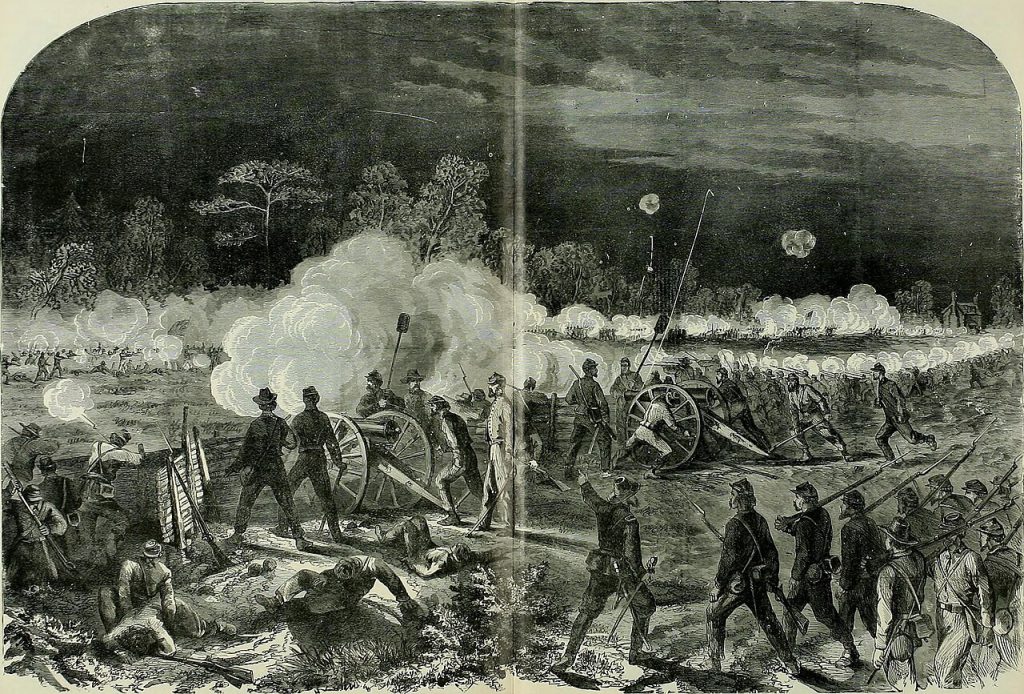
True to his predictions, Theodore Vaill did serve as adjutant of the regiment. The 2nd Connecticut Heavy Artillery faced a devastating loss at the Battle of Cold Harbor on June 1, 1864. Colonel Kellogg was killed while leading a charge and the regimented suffered 323 men killed or wounded at the battle.
On June 16, 1864 Theodore Vaill wrote about his brigade commander, Colonel Emory Upton, and the newly appointed colonel of the 2nd Connecticut Infantry.
“Col. Emory Upton is a West Pointer, 25 years old, a resident of Batavia, New York, & one of the finest men I ever saw. When I saw him, it was a case of love at first sight. His coolness in fight, his kindness, his military judgement & vigor, his freedom from bluster & fuss, & his upright conduct & good habits make him the perfectest soldier I have seen. He has been commissioned a Brigadier, I understand. After Col. Kellogg’s death, Col. Upton recommended to the officers of this regiment a classmate of his—Ranald MacKenzie, a Captain of Engineers, & so great was our confidence in Upton that all the officers signed a petition for his appointment to the Colonelcy, & in view of the probability of his appointment, Gen. Meade ordered him to take command. We like him very much but he is a tiger of a disciplinarian.”
Theodore Vaill served with the 2nd Connecticut Infantry until the end of the war and mustered out on August 18, 1865. He married Alice Mercy Dudley and later wrote a history of the 2nd Connecticut Heavy Artillery which is available to read on archive.org. He died in 1875.
We’d like to give a special thanks to William Griffing of Spared & Shared for his work in transcribing and sharing these letters.
To read more of Theodore Vaill’s letters as well as access thousands of other letters and Civil War documents, sign up for a Research Arsenal membership.
If you enjoyed this article, check out some of our other featured collections like Henry Chandler Smith of the 1st New York Mounted Rifles and William Walker of the 17th Illinois Infantry.
